

Article Index
|
5 Key Takeaways
|
While the world’s attention has been captured by geopolitical conflicts and market volatility, a fundamental shift has occurred in the bedrock of the global financial system. The United States has begun the largest infrastructure upgrade in history, moving the “plumbing” of the economy—every stock, bond, building, and Treasury note—onto public blockchains.
This is not a “crypto trend.” It is the transition from a manual, analogue financial system to a high-speed, digital-native one.
The Era of Tokenisation
At the heart of this shift is Real World Asset (RWA) tokenisation. This process takes a physical or financial asset and converts it into digital tokens on a blockchain. The efficiency gains are undeniable: operational costs are slashed by 30-50%, and settlement times are reduced from weeks to mere seconds.
The growth is staggering. In 2020, the RWA market was a niche $100 million sector ignored by major players. By 2025, it exploded to $26 billion, representing a 380% growth rate in just three years. Leading this charge is BlackRock’s “BUIDL” fund, which recently hit $2.9 billion.
Projections for 2030 suggest this is only the beginning. While McKinsey offers a conservative $4 trillion estimate, firms like BCG and Standard Chartered project between $16 trillion and $30 trillion in tokenised assets. By the end of this decade, it is estimated that 10% of global GDP will live on-chain.
The Quiet Regulatory Revolution
This migration wasn’t just a market trend; it was paved by specific, quiet regulatory milestones that reached a climax in early 2026.
On March 17, 2026, the SEC and CFTC issued a joint ruling officially classifying Bitcoin, Ethereum, Solana, and XRP as digital commodities. This provided the legal green light for massive institutional adoption. Simultaneously, Nasdaq received approval to trade tokenised securities for the Russell 1000 and major ETFs, merging the world’s most advanced stock exchange with blockchain technology.
From Petrodollar to the “On-Chain Dollar”
This technological shift serves a vital geopolitical purpose. For fifty years, US dollar supremacy was tied to the “petrodollar”—the global agreement that oil would be traded in USD. As that system began to fray (notably when Saudi Arabia allowed its long-standing deal to lapse), the US pivoted to a new source of demand: the On-Chain Dollar.
By tokenising US Treasuries, the US has created a “digital export.” Every time a foreign investor or a global stablecoin provider buys a tokenised Treasury note, they are creating demand for the US dollar. This new system doesn’t need oil pipelines or OPEC’s permission; it lives on decentralised rails accessible 24/7 to anyone with an internet connection.

A New Strategy for National Debt
This brings us to the rumours surrounding the US national debt. With debt levels surpassing $38 trillion, the administration has begun using digital assets as a strategic tool for fiscal stability.
- The Strategic Bitcoin Reserve: Following executive orders in early 2025, the US has institutionalised its Bitcoin holdings, moving toward a goal of 1 million BTC to act as “digital gold” on the national balance sheet.
- The GENIUS Act: This legislation established a federal framework for stablecoins, ensuring they are backed 100% by US Treasuries. This effectively turns every global stablecoin user into a financier of US debt.
- Debt Management: While the government hasn’t “swapped” the debt for crypto, it is building a system where the appreciation of digital reserve assets and the massive global demand for “on-chain” dollars provide a long-term hedge against inflation and debt imbalances.
The Final Shift
The race is no longer between “crypto” and “traditional finance.” Traditional finance has become crypto. Major institutions like JPMorgan, Goldman Sachs, and Franklin Templeton aren’t just experimenting; they are operating on the new rails.
The regulatory framework is complete, the institutional funds are flowing, and the US is positioning the dollar to dominate the digital age of Web3 just as it dominated the industrial and internet ages. The world is watching the headlines, but the real power is moving silently onto the blockchain.
Digital Tokens On a Blockchain
To understand “digital tokens on a blockchain” in the context of the global economy, it helps to break it down into two parts: the Token (the digital “thing” you own) and the Blockchain (the secure “ledger” that tracks it).
1. What is a “Digital Token”? (The Digital Certificate)
Imagine you own a piece of a high-end apartment building. Normally, your proof of ownership is a thick stack of paper deeds kept in a government office.
In this new system, that paper is replaced by a Digital Token.
- Think of it like a Digital Concert Ticket: Just as a ticket on your phone proves you have the right to a specific seat, a digital token proves you own a specific slice of a real-world asset (like $1,000 worth of a gold bar, a building, or a government bond).
- Fractional Ownership: Because it’s digital, we can “slice” expensive things into tiny pieces. Instead of needing $10 million to buy a whole building, you could buy a $100 token representing a small fraction of it.
2. What is a “Blockchain”? (The Unhackable Spreadsheet)
If a token is the “receipt,” the blockchain is the World’s Most Secure Spreadsheet that lists who owns which receipt.
- The “Glass Box” Analogy: Imagine a long row of glass boxes in a public square. Everyone can see what is inside every box, but only the person with the right key can open their specific box.
- No Middleman: Traditionally, if you want to prove you own a stock or a house, you have to ask a bank or a government office to check their private books. With a blockchain, the “book” is public and updated instantly.
- Permanent & Unchangeable: Once a transaction is written on the blockchain, it cannot be erased, edited, or faked. This creates “instant trust” between two people who don’t know each other.
3. Putting it together: Why does this matter?
When the document says the economy is being “tokenised,” it means we are taking things that are currently slow, paper-based, and expensive and turning them into fast, digital, and cheap tokens.
| Traditional Way | The Tokenized Way (Blockchain) |
| Paper Deeds & Certificates: Easy to lose, hard to verify. | Digital Tokens: Impossible to lose or fake; verified instantly. |
| Middlemen: You need lawyers, brokers, and banks to move money. | Direct: You send the token directly to someone else in seconds. |
| Market Hours: Banks and stock markets close on weekends. | 24/7: The blockchain never sleeps; you can trade at 3 AM on a Sunday. |
| High Entry Bar: You must be rich to buy a “whole” gold bar or building. | The Tokenised Way (Blockchain) |
The Relationship Between a Token and Bitcoin/Crypto
To understand the relationship between a token and Bitcoin/Crypto, it helps to think of it like the relationship between a passenger and a train system.
1. The Fundamental Difference: Coins vs. Tokens
In the world of digital assets, we generally divide things into two categories: Coins (the infrastructure) and Tokens (the applications).
- Bitcoin (and Ether) are “Coins”: These are the “Native” assets. A coin is like the actual train and the tracks it runs on. It has its own dedicated blockchain (the Bitcoin Network) and its primary job is to power that network and act as a form of money.
- Tokens are “Passengers”: A token does not have its own tracks. Instead, it “rides” on an existing blockchain like Ethereum or Solana. For example, if a company wants to tokenise a building, they don’t build a whole new blockchain; they create a digital token that sits on top of an existing, secure network.
2. How They Work Together
While they are different, they are deeply connected:
- The “Fuel” Relationship: To move a token (like a digital share of a building) from one person to another, you usually have to pay a small fee to the network it sits on. You pay this fee using the Native Coin. For example, to send a “House Token” on the Ethereum network, you must pay a tiny bit of “Ether” (the coin) to the miners or validators to process the move.
- The Security Relationship: Tokens are only as safe as the blockchain they ride on. This is why major institutions use the “big” names (like Ethereum or Bitcoin-linked networks) for tokenisation. They want their digital assets to be protected by the massive, unhackable security of the world’s largest crypto networks.
3. Can Bitcoin be a Token?
Interestingly, yes. Through a process called “Wrapping,” you can take a Bitcoin and turn it into a token so it can be used on other networks.
- Think of it like a Casino Chip: You leave your $100 bill (the Bitcoin) at the cashier’s desk (a secure vault). They give you $100 worth of chips (the Token). You can now use those chips to play games (DeFi, lending, trading) inside the casino. When you’re done, you trade the chips back for your original $100 bill.
Summary for Laymen
| Feature | Bitcoin / Crypto Coins | Digital Tokens |
| Analogy | The Train & Tracks (Infrastructure) | The Passengers (Assets) |
| Ownership | Operates its own independent ledger. | Rides on someone else’s ledger. |
| Purpose | To act as money or power the network. | To represent something else (gold, real estate, a dollar). |
| Dependency | Self-sufficient. | Needs a native coin to pay for its “travel” fees. |
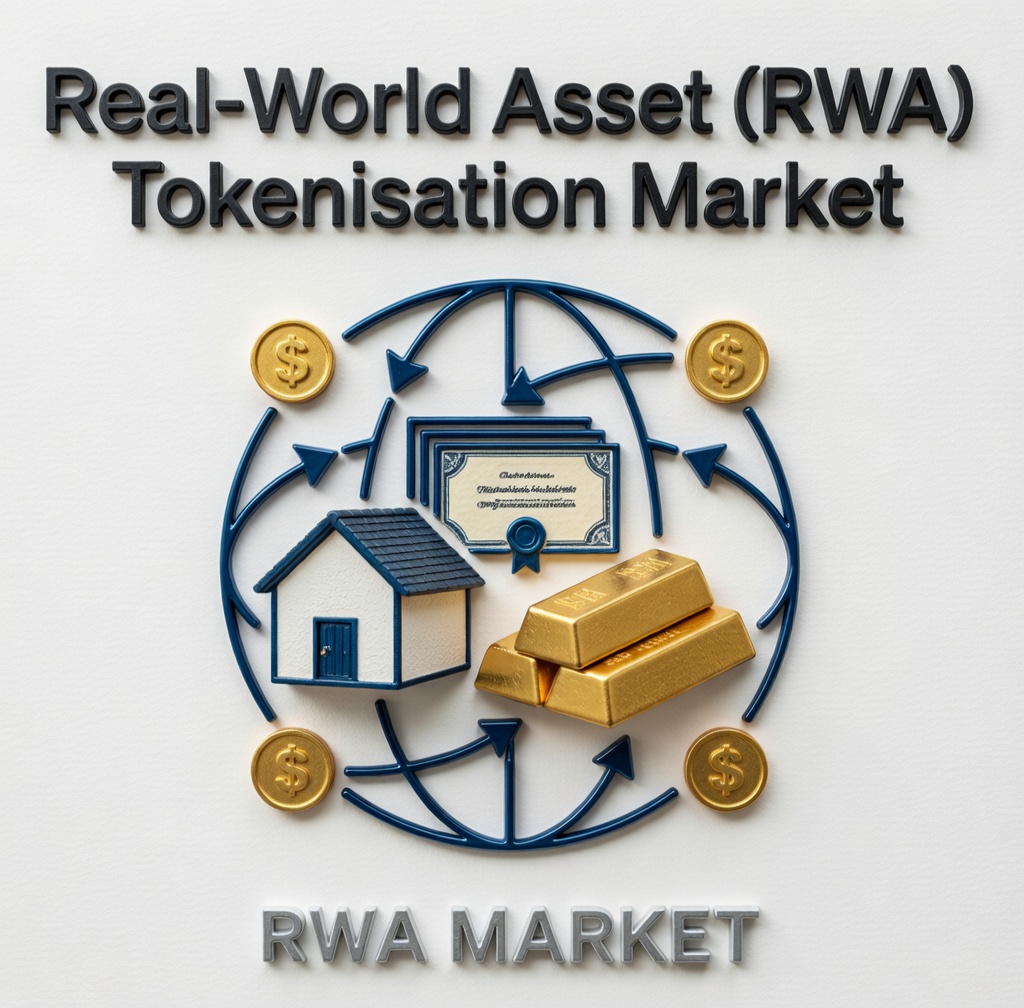
Real-World Asset (RWA) Tokenisation Market
The RWA (Real-World Asset) tokenisation market is a rapidly growing sector of the financial world that involves taking “real” physical or traditional assets—such as real estate, gold, government bonds, or private credit—and turning them into digital tokens on a blockchain.
Think of it as the “digital bridge” between the multi-trillion-dollar traditional economy and modern blockchain technology.
1. How the Market Works
The process typically follows three main steps:
- Verification: A real-world asset (like a $10 million office building) is appraised, and its legal ownership is confirmed.
- Legal “Wrapper”: A legal structure (like a Special Purpose Vehicle) is created to hold the asset, ensuring the digital tokens legally represent a claim to that physical property.
- Minting: Digital tokens are “minted” on a blockchain (like Ethereum or Solana). Each token might represent a $100 “slice” of that $10 million building.
2. Current Market Size and Growth
As of late 2025 and early 2026, the market has shifted from a theoretical experiment to a massive institutional reality:
- Recent Value: The market reached approximately $36 billion by November 2025, having grown over 2,200% in the preceding five years.
- Dominant Sectors: Private Credit (loans to businesses) is currently the largest segment, making up over 50% of the market. U.S. Treasuries are the second largest, as investors seek “on-chain” versions of safe, yield-bearing government debt.
- Major Players: BlackRock’s BUIDL fund is a market leader, managing nearly $2.9 billion in tokenised assets.
3. Why it is Growing (The “Killer Use Case”)
The market is expanding because it solves several “pain points” in traditional finance:
- Fractional Ownership: You no longer need millions to invest in commercial real estate or fine art; you can buy a $50 tokenized “share.”
- 24/7 Liquidity: Unlike the stock market or real estate, which have “opening hours” and take days to settle, tokenised assets can be traded instantly at any time of day, 365 days a year.
- Operational Efficiency: By automating paperwork via “smart contracts,” institutions can reduce costs by 30-50% and settle trades in seconds rather than weeks.
4. Future Projections (2030)
Major global institutions have provided a wide range of estimates for where this market is headed by 2030, depending on how much of the global economy moves “on-chain”:
- McKinsey (Conservative): $2 trillion – $4 trillion.
- Boston Consulting Group (BCG): $16 trillion (approx. 10% of global GDP).
- Standard Chartered (Optimistic): $30 trillion.
In simple terms, the RWA market is the process of putting the “real world” on the blockchain to make it faster, cheaper, and more accessible to everyone.
What is a Stablecoin?
To understand a stablecoin, think of it as a digital bridge that combines the stability of the US dollar with the high-speed technology of a blockchain.
While most cryptocurrencies (like Bitcoin) are famous for their prices swinging wildly, a stablecoin is designed to stay stable, usually pegged exactly to the value of $1.00.
1. How does it stay at $1.00? (The Collateral)
Most reputable stablecoins work like a digital pawn shop or a gold standard:
- The Reserve: For every 1 “digital dollar” (stablecoin) created, the company behind it must hold $1.00 of real assets in a bank vault or a secure account.
- The Backing: These reserves aren’t just cash; they are often US Treasury Bills (government debt). This is the “secret sauce” mentioned in your document: by holding trillions of dollars in government debt to back these coins, stablecoin companies have become some of the largest lenders to the US government.
2. Why use a Stablecoin instead of a regular Bank?
If it’s just a digital dollar, why not just use a standard bank account? Stablecoins offer “superpowers” that traditional banks don’t:
- No “Closing Time”: You can send $1 million to someone on the other side of the world at 3:00 AM on a Sunday, and it arrives in seconds. A bank would take 3-5 business days.
- Programmable Money: Because they are “tokens,” you can write computer code (Smart Contracts) that says: “Only pay this person the stablecoins once the digital deed to the house is transferred to me.” This eliminates the need for expensive escrow agents or lawyers to middleman the deal.
- The “On-Chain” Life: To buy a tokenised building or a tokenised gold bar (RWAs), you can’t use “paper” dollars. You need “digital” dollars that live on the same blockchain highway as the assets.
3. The GENIUS Act (2025/2026)
As mentioned in the recent regulatory updates, the US passed the GENIUS Act to officially regulate this.
- The Rule: It mandates that stablecoin issuers must back their coins 1-to-1 with safe assets (like Treasuries) and subjects them to federal audits.
- The Result: This turned stablecoins from “risky crypto experiments” into a legitimate pillar of the US financial system.
Summary: The “Digital Dollar”
| Feature | Traditional USD (Bank) | Stablecoin (Blockchain) |
| Speed | 1–5 Days (Slow) | Seconds (Instant) |
| Availability | Monday–Friday, 9–5 | 24/7/365 |
| Control | Controlled by the Bank | Controlled by your Digital Wallet |
| Global Access | Requires a US Bank Account | Accessible to anyone with internet |
Stablecoins are the “liquidity” that makes the whole tokenised economy work. They are the currency used to buy and sell every other tokenised asset on the planet.